



Special Report
Showing 1–10 of 152 results
-

Analysis Report on Perovskite Materials: Industry and Application Technologies
₩0September 22, 2026
“Analysis Report on Perovskite Materials: Industry and Application Technologies” provides an in-depth analysis of perovskite materials, from crystal structure, key properties and stability challenges to their two major application areas, displays and solar cells, covering Mini-LED color conversion, in-pixel color conversion (In-Pixel CC), self-emissive PeLEDs and perovskite/silicon tandem solar cells (PSTSC). It also examines the supply chain by process, patent and certification trends, and the market outlook through 2035.
-

2026 Automotive Display: Technology, Supply Chain & Market Outlook
₩0September 17, 2026
UBI Research’s newly published report, 2026 Automotive Display: Technology, Supply Chain & Market Outlook, provides an integrated analysis of the rapidly evolving automotive display industry, examining technologies, application areas, and supply chain changes driven by the expansion of software-defined vehicles (SDVs) and smart cockpits.
The automotive display market is expected to grow in overall shipments while shifting toward a higher proportion of high-value-added displays. Although LCD shipments are projected to decline slightly through 2030, Mini LED shipments are forecast to increase approximately 2.9-fold, from 8.78 million units in 2026 to 25.06 million units in 2030. OLED shipments are also expected to more than double over the same period, rising from 6.15 million to 12.99 million units. As a result, market competition is expected to shift from shipment volume expansion toward high-value-added technologies offering superior image quality, higher brightness, and larger screen sizes.
The report examines how automotive displays are expanding beyond information displays centered on clusters and center information displays (CIDs) into passenger displays, rear-seat entertainment (RSE), camera monitoring systems (CMS), head-up displays (HUD), and augmented reality head-up displays (AR-HUD). It explores the growing number, screen area, and performance requirements of displays resulting from the transition to SDVs and smart cockpits. The report also analyzes rising AR-HUD demand driven by advances in ADAS, together with the shift toward multiscreen and content-centered experiences resulting from the expansion of passenger HMI. In addition, it outlines how emerging form factors—including Shy Tech, transparent displays, and transformable displays—are becoming key elements in differentiating user experiences and vehicle interiors.
The scope of competition is also expanding from panels to modules and systems. The conventional structure, in which panel suppliers provide displays and Tier 1 suppliers handle system integration, is evolving toward joint design involving panel makers and Tier 1 suppliers from the early stages of development. The supply scope is also progressing from FOG to FIDM and FIDM Plus. As the integration of touch solutions, cover glass, PCBAs, sensors, and other components increases, Tier 1 suppliers are creating greater value through cockpit computing, HMI software, and system integration. The report analyzes these changes in the supply structure and the evolving roles of OEMs, Tier 1 suppliers, and panel makers.
It also compares the technological characteristics of TFT-LCD, Mini LED, OLED, and Micro LED with the performance requirements of automotive applications. In addition, it reviews the automotive display strategies and market outlooks of major panel manufacturers, including AUO, BOE, LG Display, Samsung Display, TCL CSOT, Tianma, and Visionox.
Rather than simply listing individual technologies and market data, the report presents an integrated analysis that connects the growth drivers of the automotive display market with product applications, technology selection, modularization, supply chain restructuring, and the business strategies of major companies. It enables readers to identify where the competitive landscape is shifting and where new sources of added value and business opportunities are emerging. The report also provides practical criteria to support market entry, product development, customer strategies, and supply chain planning for companies involved in panels, materials, components, equipment, and automotive electronics -

QD Materials: Display Technologies and Industry Analysis
₩0September 10, 2026
“QD Materials: Display Technologies and Industry Analysis” covers the full range of applications, from the properties and synthesis of QD materials through to LCD backlights, QD-OLED, emissive QD-LED and micro LED for XR, and presents an in-depth view of shifts in the global material supply chain together with a market forecast to 2030.
The report is organized into six chapters, beginning with the classification of QD materials and moving through industry trends and the market forecast, color conversion materials, emissive devices, micro LED for XR, and high-resolution patterning.
On the market outlook, the shipment area of QD-applied LCD panels (QDEF/Plate) is analyzed to expand from 42.75 million m² in 2025 to 63.22 million m² in 2030. The core driver of this growth is wider adoption of Mini-LED TV, for which the QD material shipment area rises from 16.28 million m² to 27.68 million m² over the same period. QD material revenue is likewise expected to grow from about 128 million dollars in 2025 to about 190 million dollars in 2030. For QD-OLED, the report identifies the shift of the growth axis from TV to monitors. Monitor panel revenue expands from about 980 million dollars in 2025 to about 4,635 million dollars in 2030, while TV panel revenue declines from about 699 million dollars to 663 million dollars, and the report analyzes the corresponding 8.5G capacity roadmap together with the effect of ink recycling on QDCC material revenue.
On color conversion materials, the report compares which applications favor QD, KSF phosphor and perovskite for red conversion, and sets out countermeasures for the issues common to in-pixel color conversion: leakage of unabsorbed blue light, the shift of the emission peak caused by reabsorption, and the loss of contrast under ambient light. For emissive QD-LED, it compares the size, resolution, color gamut, efficiency and lifetime of prototypes from BOE, Sharp, Visionox and TCL, and addresses both the split in pixel formation between inkjet and PR-free direct photolithography and the real bottleneck of blue material lifetime.
In the XR and micro LED field, the report examines the sharp efficiency loss of AlGaInP red LED as chip size falls below 10 μm and the blue InGaN plus QD color conversion approach that has emerged as the answer. It presents the competing routes to full color — individual RGB transfer, monolithic RGB integration, wavelength-tunable pixels (DPT) and three-panel optical combining — and organizes patterning technologies by applicable range, from the 300 ppi limit of inkjet and the EHD printing that goes beyond it, to QDPR photolithography aimed above 2,000 ppi, transfer methods reported up to 2,460 ppi, and FMM deposition for perovskite. It also systematically compiles the key specifications of the QD inkjet printing process and the associated material conditions (QD composition, particle size, solvent selection, synthesis conditions and so on), providing a practical roadmap for realizing high-definition displays.
This report offers value as a comprehensive analysis that connects material properties, process technology, supply chain and market outlook organically, rather than centering on market figures alone. Grounded in the latest disclosures including SID 2026, it is expected to provide a substantive basis for strategy among decision makers across the industry, including display manufacturers, material and component companies, investment institutions and policy bodies. -

3Q 2026, AMOLED Emitting Material Market Tracker
₩0August 27, 2026
The quarterly emitting material market tracker investigates sales and sales volume by OLED emitting layer and common layer to understand the overall market for emitting materials. Performance analysis was categorized by country, panel maker, application product, layer, OLED method (RGB, WRGB, QD-OLED). A report of quarterly performances for three years is organized and provided. Market information up to 2030 was forecasted by predicting the amount of luminescent material usage and sales by company for the next five years. The Market Track Quarterly Report provides necessary information to professionals leading the OLED industry.
-

3Q 2026, Small OLED Display Market Tracker
August 26, 2026
This market tracker analyzes the OLED production capacity for 10-inch or smaller OLED displays, categorized by major panel makers, countries, generations, substrates, TFT technologies, and application products (Watch, Smartphone, Foldable phone). Detailed quarterly sales and shipments for product groups were investigated. It analyzes ASP by application, OLED demand/supply, and provides market forecast analysis data for small OLED displays for the next 5 years until 2030.
-

3Q 2026, Medium & Large OLED Display Market Tracker (C
August 26, 2026
This market tracker analyzes the current state of OLED production capacity for 10-inch and larger OLED displays categorized by major panel makers into major product groups such as Automotive, Note PC, Monitor, and TV. Detailed quarterly sales and shipments for product groups were investigated. Analysis of market forecasts 5 years later, such as ASP by application and OLED demand/supply analysis, are also provided.
-

2026 In-Depth Technical Report on Foldable Displays
₩0August 19, 2026
2026 is expected to mark a turning point where the foldable market—which has been stagnant for three years—takes a significant leap forward, driven by the launch of Apple’s first foldable iPhone and the expansion of Samsung Electronics’ Galaxy Z Fold 8 lineup.
Behind this market expansion lies comprehensive technological innovation spanning hinge design, cover window materials, display stacking structures, and backplate materials. In particular, 2026 marks the year when crease reduction shifts from a hinge-centric approach to panel-level structural control. Multiple material technologies—including thicker UTG, multi-neutral-plane design, laser-drilled titanium plates, dual UTG (GMF), and liquid-metal hinges—are converging simultaneously, driving system-level integration toward “zero creases.” In this process, the supply chains for key components and materials—such as UTG, OCA, backplates, and hinges—are also rapidly restructuring, and a clear pattern is emerging where the technological dominance of Korean companies intersects with the pursuit by Chinese competitors.
The “2026 In-Depth Technical Report on Foldable Displays” comprehensively analyzes this turning point in the foldable industry across four dimensions: market, product, technology, and supply chain. In the market trends section, the report examines trends in foldable OLED shipments and revenue, as well as shifts in market share by manufacturer. In the product trends section, it analyzes the specifications and competitive landscape of major foldable devices expected in 2026, such as the Galaxy Z Fold 8, Apple iPhone Fold, and Huawei Pura X Max. Furthermore, the report provides an in-depth overview of the technology roadmaps of panel manufacturers, as well as the stacking structures and materials of foldable OLEDs, internal and external hinge technologies, and the principles and current applications of crystal reduction technologies. In particular, the report mapped out the key supply chains for materials and components—including UTG (DOWOOINSYS, Econy, Lens Technology), backplates (Fine M-Tec, EonTec), OCA (Samsung SDI, 3M), and hinges (KH Vatec, Huanli, SZS)—by manufacturer, highlighting the direction of supply chain restructuring resulting from Apple’s entry into the market. Finally, the report broadly covered development trends for next-generation form factors, such as rollable and slider devices. -
2026 OLED Emitting Materials Report
₩0June 9, 2026
As OLED expands beyond the smartphone market into IT devices and automotive display applications, OLED panel structures and emitting material sets are changing rapidly. OLED image quality characteristics are partly derived from panel structure, but its intrinsic characteristics are determined by the performance of the emitting materials themselves.
The greatest advantage of RGB mini-LED LCD, which has recently emerged as a major topic in the display market, is its color performance, enabling a wide color gamut that meets BT.2020. To secure an early lead in the emerging BT.2020 era, OLED panels based on new material sets capable of dominating the smartphone, IT device, and TV markets are undergoing technology development and mass-production validation, while preparing for market launch.
The “2026 OLED Emitting Material Report” summarizes color gamut competition by OLED product category and technology roadmaps by panel maker in preparation for the BT.2020 era, and analyzes changes in the structures of OLED panels for smartphones, IT devices, and TVs, as well as the direction of emitting material adoption.
In addition, next-generation emitting material technologies such as PSF, TADF, hyperfluorescence, blue phosphorescence, deuterium substitution, and boron-based blue dopants are classified and summarized from the perspectives of efficiency, lifetime, and color coordinate improvement. The report also analyzes the development directions of major emitting material companies and the supply chain expansion movements of Chinese material companies. -

2Q 2026, AMOLED Emitting Material Market Tracker
₩0June 2, 2026
The quarterly emitting material market tracker investigates sales and sales volume by OLED emitting layer and common layer to understand the overall market for emitting materials. Performance analysis was categorized by country, panel maker, application product, layer, OLED method (RGB, WRGB, QD-OLED). A report of quarterly performances for three years is organized and provided. Market information up to 2030 was forecasted by predicting the amount of luminescent material usage and sales by company for the next five years. The Market Track Quarterly Report provides necessary information to professionals leading the OLED industry.
-
2Q 2026, Small OLED Display Market Tracker
May 19, 2026
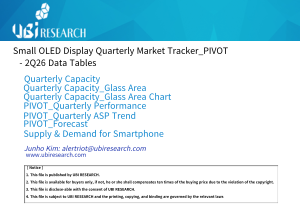
This market tracker analyzes the OLED production capacity for 10-inch or smaller OLED displays, categorized by major panel makers, countries, generations, substrates, TFT technologies, and application products (Watch, Smartphone, Foldable phone). Detailed quarterly sales and shipments for product groups were investigated. It analyzes ASP by application, OLED demand/supply, and provides market forecast analysis data for small OLED displays for the next 5 years until 2030.