



Special Report
2021 Inkjet Technology Trend for Display Report
₩5,000,000
October 22, 2021
Introduce
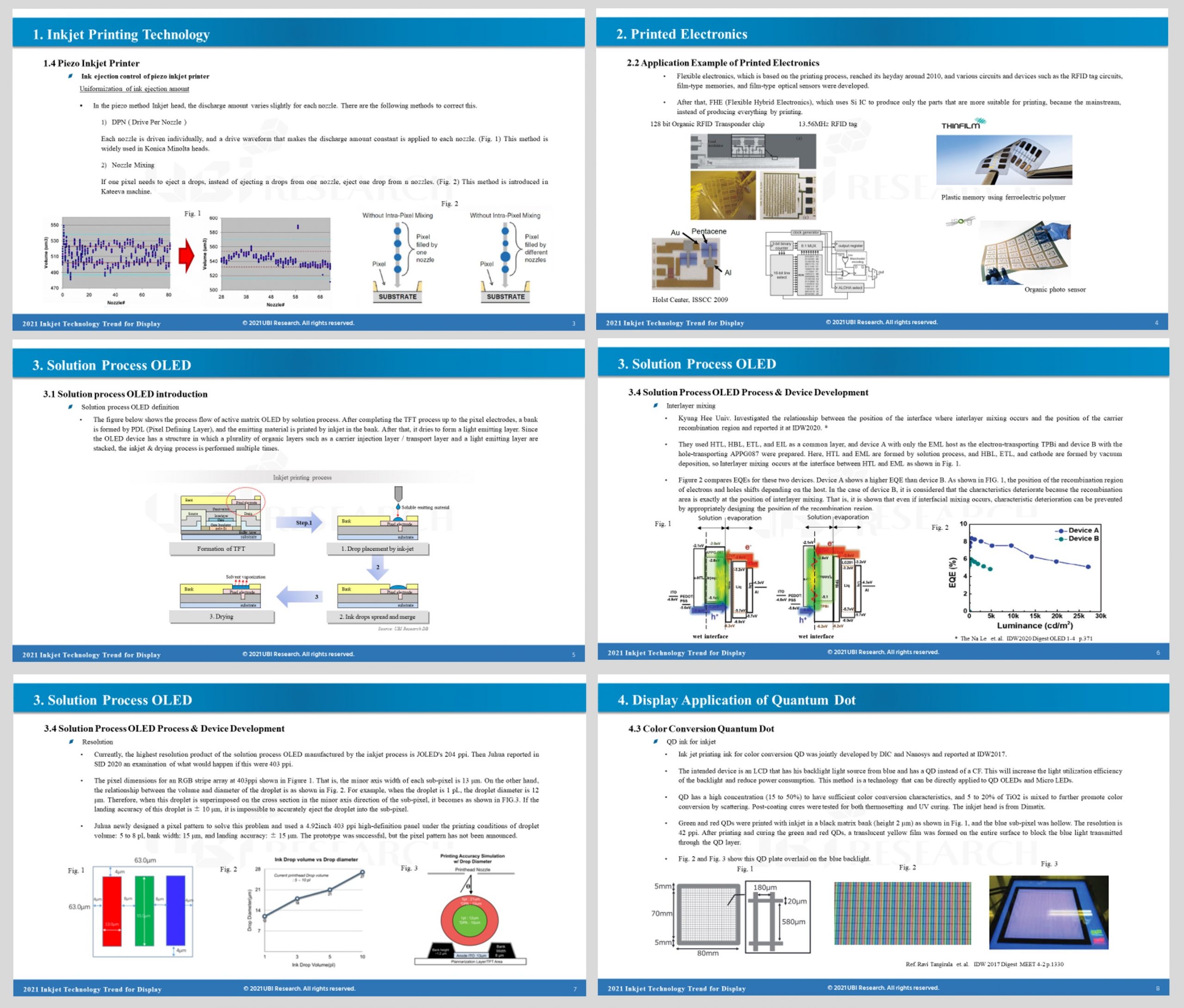
This report focuses on inkjet devices and technologies used in OLED and QLED. Inkjet equipment was created by separating the companies that manufacture inkjet heads and systems.
As inkjet head makers, Fujifilm Dimatix, Epson, Konica Minolta, Ricoh, Xaar, and Panasonic were mentioned, and OLED encapsulation equipment makers Kateeva and UniJet were described.
Litrex, TEL (Tokyo Electron), Kateeva, Panasonic Production Engineering, and Toray Engineering are mentioned as inkjet device manufacturers used for Sol OLED.
Contents
1. Inkjet Printing Technology
1.1 Printing Technology Classification
1.2 Inkjet Printing Technology Classification
1.3 Thermal Inkjet Printer
1.4 Piezo Inkjet Printer
1.5 Piezo Inkjet Head
1.6 Application of Inkjet Printing to Display
2. Printed Electronics
2.1 What is Printed Electronics?
2.2 Application Example of Printed Electronics
2.3 Materials for Printed Electronics
2.4 Inkjet Process in Printed Electronics
2.5 Printed Electronics Application Devices
3. Solution Process OLED
3.1 Introduction to Solution Process
3.2 Materials for Solution Process
3.3 Solution Process Inkjet equipment for OLED
3.4 Solution Process OLED Process & Device Development
3.5 Solution Process OLE Display Development
4. Display Application of Quantum Dot
4.1 What is Quantum Dot?
4.2 Positioning of Quantum Dot in Display
4.3 Color Conversion Quantum Dot
4.4 Emission Type Quantum Dot
5. Further Technological Development
5.1 Electro Hydrodynamic ( EHD ) Printing
5.2 Ultra High-Definition Inkjet: XTPL
5.3 Organic Vapor Jet Printing (OVJP)
Report Sample
Previous Report Status
Related Products
-
2019 Solution Process OLED Annual Report
₩5,000,000March 31, 2019
Solution process using inkjet OLED (sol OLED) has been developed mainly as a large OLED panel for TV, but recently began to attract attention in the monitor display market. The evaporation method with FMM that produces OLED for smartphones has a bending phenomenon of FMM. Thus, the substrate is used by dividing into two or four. Since smartphone-sized FMMs are used by attaching 10 to 15 sheets to the mask frame, the profitability is very low due to the small number of cells in the production of 20-inch or larger monitors.
-
101 inch Micro-LED Set BOM Cost Analysis For TVs
₩0March 4, 2026
In-Depth Cost Structure Analysis of True Micro-LED TVs: Integrated Analysis of BOM Cost (Based on 101-inch) While Micro RGB backlight-based LCDs currently dominate the 100-inch and larger ultra-large TV market, the commercialization of True Micro-LED TVs, the pinnacle of self-emissive technology, will be a turning point that fundamentally reshapes the premium TV sector.
UBI Research has officially released a technical report providing an integrated analysis of the precise cost structure and process-specific yield of Micro-LED sets for TVs. -
2026 Analysis Report on China’s OLED Supply Chain Management
₩0May 1, 2026
The newly published ‘2026 Analysis Report on China’s OLED Supply Chain Management’ is the first in the industry to organize, at a glance, the customer landscape and business stage of a wide range of OLED materials, components, and equipment companies in China. It is expected to serve as a practical guideline for global companies seeking to enter China’s steadily expanding OLED market.
The way panel makers build and maintain their supply chain management is a key determinant of their technological competitiveness. SCM is critically important not only for panel manufacturers, but also for materials, components, and equipment suppliers. To succeed in business, companies must clearly understand who their customers are, who their competitors are, and, for new entrants, how the existing market structure is already laid out.
There is a common denominator behind Samsung Display’s position as the global leader in panel technology and Apple’s strong leadership in the OLED smartphone business: SCM. The biggest reason Chinese panel makers and set manufacturers have not been able to scale as rapidly in OLED as they did in LCD is the supply chain. It is not possible to free-ride on the SCM networks that Samsung Display and Apple have already built.