



Special Report
Micro Display Technology Report
₩5,000,000
December 15, 2021
Introduce
Glasses-type wearable devices are attracting attention as cutting-edge IT products that will succeed smartphones and smart watches. Wearable devices are being used in various industries, from AR and VR to XR and MR. Google, Facebook, and Sony are already releasing AR Glass with various performances, and are spurring software development along with hardware development. The most important part of the glasses-type wearable device is the micro display. In particular, AR, XR, and MR devices are required to display high definition, high brightness, and light weight because virtual reality or augmented reality must be displayed in accordance with reality. This report analyzed the latest development trends of micro display and included them by technology. It is structured so that companies that are promoting the next-generation wearable device business and software business can know the direction of the micro display industry.
Contents
1.AR, VR, and XR
1.1 Overview
1.2 VR
1.3 AR
1.4 XR
1.5 XR Device
1.6 Micro Display
2.AR Development Trend
2.1 Evolution of Information Device and Display
2.2 Near-Eye Display Products
2.3 Optical System of Near-Eye Display
2.4 Retina Scanning Type Display
2.5 Waveguide Optical System
2.6 Industry Eco-System of Waveguide Grating Combiner
2.7 Pin Mirror Method
2.8 Micro Mirror Structure Method
2.9 Non-Emissive Micro-Display
2.10 Emissive Micro-Display
2.11 Major Product Development Trends
3.Micro-OLED
3.1 Micro-OLED Business Situation
3.2 High Definition of White + CF Type Micro-OLED
3.3 High Brightness of White + CF Type Micro-OLED
3.4 Micro-OLED Direct Patterning: Lithography
3.5 Micro-OLED Direct Patterning: FMTL
3.6 Micro-OLED Direct Patterning: Ultra High-Definition Mask
3.7 Smart Glass Using Pin Mirror
4.Monolithic Micro-LED
4.1 Hybridization of Monolithic Micro-LED and Driver Chip
4.2 Improved Mass Productivity of Monolithic Micro-LED
4.3 Monolithic TFT on GaN micro-LED
4.4 Monolithic Micro-LED Full Color
4.5 Commercialization of Monolithic Micro-LED
5.Micro-OLED or micro-LED ?
5.1 Micro-LED or Micro-OLED?: View from Micro-OLED
5.2 Brightness Comparison: Micro-LED vs. Micro-OLED
5.3 Full Color: Micro-LED vs. Micro-OLED
5.4 Driving Method And Others: Micro-LED vs. Micro-OLED
6.VR Display and Device Development Trend
6.1 Samsung Display
6.2 LG Display
6.3 Facebook and HTC
Report Sample
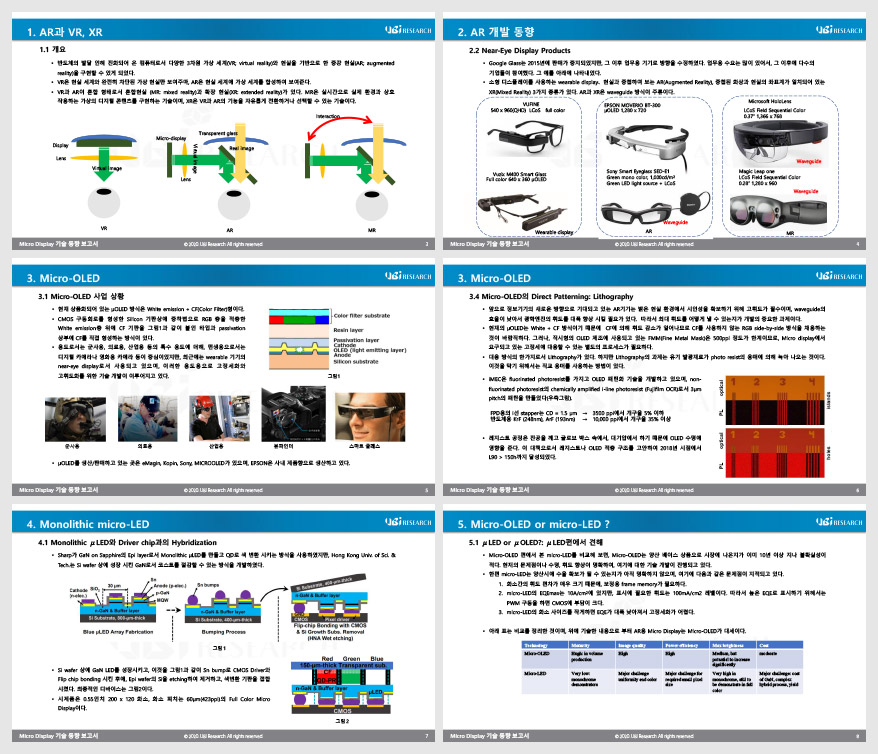
Previous Report Status
Related Products
-
2024 XR Devices and Micro-display Megatrends Analysis Report
₩0September 9, 2024
XR is emerging as a key industry that will drive the next generation of IT, following the innovations brought by smartphones, and holds immense value. In the 21st century, smartphones revolutionized the IT industry by integrating features like cameras, gaming, and digital wallets, becoming the leading IT device that continues to evolve.
-
2024 OLEDoS Industry and Technology Report
₩0October 30, 2024
This report is centered around OLEDoS (Organic Light Emitting Diode on Silicon) technology, providing a comprehensive analysis of XR devices, market conditions, industry trends, and key manufacturing and technical issues. It covers the current state of product development, major technological challenges, supply chain analysis, and essential materials. The report highlights the latest trends in the XR market and underscores the critical role OLEDoS plays in XR devices, offering a detailed analysis of key technologies and material advancements.
OLEDoS combines the advantages of both LCoS and LEDoS while addressing their limitations, making it the most promising micro-display technology for XR devices due to its scalability for mass production. The report thoroughly outlines the significant technical issues associated with OLEDoS and includes research trends aimed at solving these challenges.
The success of the OLEDoS industry hinges on strong collaboration between the supply chain, manufacturers, consumers, and research institutions. This report is designed to offer valuable insights into the cooperative efforts necessary to drive success in the OLEDoS sector. -

XR Industry Trends and OLEDoS Display Technology & Industry Analysis Report
₩0December 3, 2025
The newly published report, “XR Industry Trends and OLEDoS Display Technology & Industry Analysis” provides a comprehensive overview of the rapidly evolving XR ecosystem and next-generation display technologies. XR devices deliver new user experiences centered on spatial computing, with both AR and VR/MR undergoing rapid changes. The market is showing renewed growth momentum driven by new product launches from multiple manufacturers and platform expansions. Particularly, the AR smart glasses sector is expanding significantly, driving an industry-wide shift in technological focus toward lightweight, low-power, and ultra-compact designs.