



Reports
2025 OLED Emitting Materials Report
₩0
May 7, 2025
Introduction
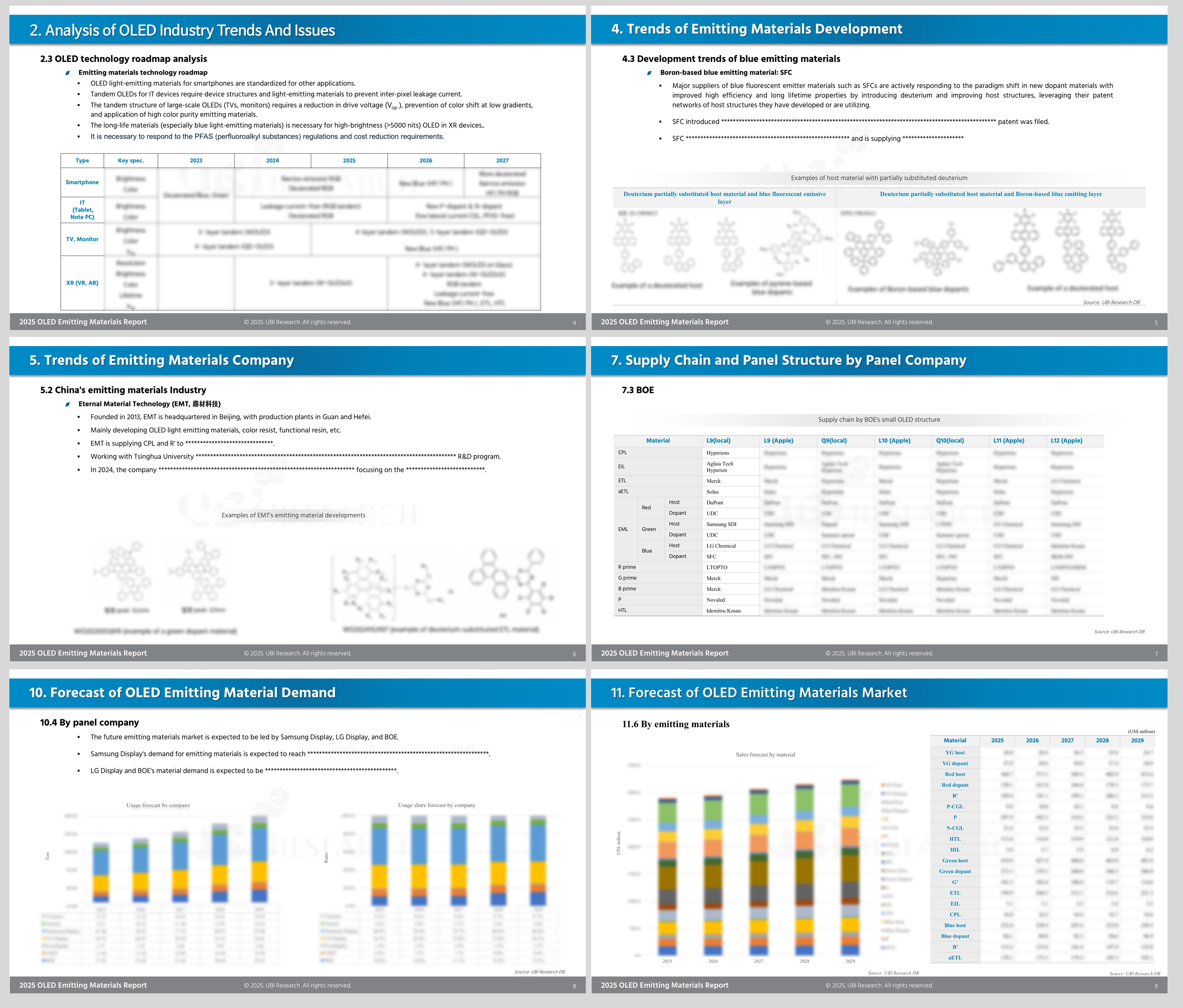
“2025 OLED Emitting Materials Report” analyzes the latest trends and key issues in the OLED industry, offering a comprehensive review of the technology development directions of OLED panel makers and emitting material manufacturers. The report also includes an in-depth analysis of OLED panel production capacities, supply chains, and panel structures, as well as a detailed breakdown of emitting material performance and market size forecasts.
OLED displays are rapidly expanding across various sectors such as automotive, IT devices, and mid-to-low-end smartphones, driving significant growth in the emitting materials market. In particular, with the commercialization of tandem OLEDs that use multiple emitting layers, there is a surge in demand for high-performance materials such as CGL, p-dopants, and HTL. Leading panel manufacturers such as Samsung Display, LG Display, and BOE are steadily increasing their consumption of emitting materials. The global emitting materials market is projected to reach USD 2.89 billion in 2025 and USD 3.23 billion by 2029.
From a technological trend perspective, there is intense competition in high-efficiency and long-lifetime emitting technologies such as hyperfluorescence, TADF, and phosphorescent materials. Improving the external quantum efficiency and lifetime of blue materials, in particular, is emerging as a key challenge for market expansion. Amid active innovation in materials—such as deuterium substitution and boron-based fluorescent materials—Chinese companies are rapidly increasing their presence in dopant and host segments, becoming deeply embedded in the global supply chain.
This report serves as a valuable guideline for professionals in the display and materials industries by providing a comprehensive analysis of the OLED emitting materials industry, including market forecasts, major company strategies, and future technology development directions.
Contents
2. Analysis of OLED Industry Trends and Issues
2.1 OLED emitting materials sales trends
2.2 Changes in emissive layers by major OLED products
2.3 OLED technology roadmap analysis
2.4 Investment trends of 8.6G IT line
2.5 Expansion of OLED products for IT
2.6 Increase in shipments for mid- to low-priced smartphones
2.7 Increase in OLED materials shipment of China
2.8 Expansion of tandem OLED application
3. Development Trends of OLED Panel
3.1 Requirements for next generation of high-resolution displays
3.2 Panels for OLED-TVs
3.3 QD-OLED
3.4 WOLED
3.5 RGB tandem OLED
3.6 Inkjet printing OLED
4. Trends of Emitting Materials Development
4.1 Overview
4.2 Development trends of high-efficiency and long-life materials
4.3 Development trends of blue emitting materials
4.4 Development trends of deuterium-substituted materials
4.5 Development trends of emitting materials for tandem OLEDs
4.6 Development trends of common layer materials
4.7 Development trends of inkjet printing OLED
5. Trends of Emitting Materials Company
5.1 Development and business trends by major players
5.2 China’s emitting materials Industry
5.3 New businesses
6. Analysis and Outlook of OLED Panel Maker Capacity
6.1 Samsung Display
6.2 LG Display
6.3 BOE
6.4 TCL CSOT
6.5 EverDisplay Optronics
6.6 Tianma
6.7 Visionox
6.8 Line status by panel company
6.9 Annual substrate area forecast
6.10 Small OLED annual substrate area forecast
6.11 Medium and large OLED annual substrate area forecast
7. Supply Chain and Panel Structure by Panel Company
7.1 Samsung Display
7.2 LG Display
7.3 BOE
7.4 TCL CSOT
7.5 Tianma
7.6 Visionox
8. Analysis of OLED Emitting Materials Performance
8.1 Overall
8.2 By country
8.3 By panel company
8.4 By layer
8.5 By OLED structure
8.6 By feature
8.7 By application
8.8 By material company
9. Analysis of OLED Materials Market Share in 2024
9.1 Overall
9.2 Host
9.3 Dopant
9.4 HTL
9.5 ETL
9.6 Other materials
10. Forecast of OLED Emitting Material Demand
10.1 Overview
10.2 Overall
10.3 By country
10.4 By panel company
10.5 By layer
10.6 By OLED structure
10.7 By emitting material
11. Forecast of OLED Emitting Materials Market
11.1 Overall
11.2 By country
11.3 By panel company
11.4 By layer
11.5 By OLED structure
11.6 By emitting materials
Report Sample
Previous Report Status
Related Products
-
2024 OLED Emitting Material Report
₩6,000,000May 8, 2024
The “2024 OLED Emitting Material Report” analyzed the latest trends in iPad Pro OLED, which recently began production, 8.6G IT line investment trends, tandem OLED emitting material development trends, and high-efficiency and long-life emitting materials.
In the emitting material supply chain for each panel company, we analyzed Samsung Display and LG Display’s 2-stack tandem OLED materials, iPhone 16 emitting materials, and the supply chains of Chinese panel companies.
In the emitting material market performance, the performance of each material company was analyzed, and the emitting material market and demand were forecast by country, panel company, and emitting material from 2024 to 2028.
The demand for OLED emitting materials is expected to be 131 tons in 2024, and the demand for emitting materials is expected to be 177 tons by 2028 with an average annual growth rate of 8.7%.
The size of the OLED emitting materials market is expected to grow from $2.4 billion in 2024 to $2.7 billion in 2028.
Korean panel companies’ OLED emitting material purchases are expected to increase from $1.4 billion in 2024 to $1.5 billion in 2028, and Chinese panel companies’ material purchases are expected to increase from $980 million in 2024 to $1.21 billion in 2028. do. -
2022 OLED Emitting Material Report
₩6,000,000May 18, 2022
In “2022 OLED Emitting Material Report”, the current status of panel makers by line and future plans were carefully detailed. The annual substrate area was divided into small size and medium large size types and diagrammed.
The OLED industry issue analyzed Korean and Chinese panel makers’ IT line investment status and future forecasts, Samsung Display’s QD-OLED current status and future investment scenarios, and the possibility of diversification of iPhone panel suppliers.
The IT line investment included the future RGB 2stack OLED light-emitting material market and thickness for each layer.
The analysis for light-emitting material company business trends examined the reasons for the increase or decrease in the performance of each material company over the past three years. The status of major Chinese light-emitting material companies was also summarized.
The market and demand forecast from 2022 to 2026 for emitting materials will help OLED emitting material companies establish strategies for the future. -
2023 OLED Emitting Material Report
₩6,000,000May 8, 2023
In the “2023 OLED Emitting Material Report”, deals with the overall development trend of blue emitting materials, including blue phosphorescent materials that have recently attracted attention.
In the analysis of OLED industry issues, Samsung Display’s blue phosphorescent material development status, global 8.6G IT investment status, Samsung Display’s QD-OLED line future outlook, Samsung Display’s light emitting structure application status, TCL CSOT’s solution process OLED line investment possibility are included.
In the emitting material supply chain of each panel company, new emitting structures for Samsung Display’s QD-OLED and LG Display’s Guangzhou WOLED are updated, and the supply chain of Chinese panel makers is strengthened.
In the emitting material market performance, performance is analyzed by material company, and the emitting material market and demand are forecasted by country, panel company, and emitting material from 2023 to 2027.